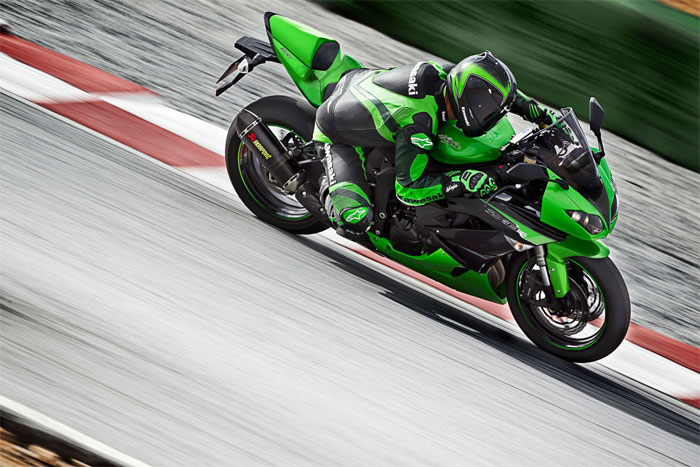
Key Performance Indicators 2013 Kawasaki ZX-10R ABS

thumbnail
Key Performance Indicators 2013 Kawasaki ZX-10R ABS

Engine Four-stroke, liquid-cooled, DOHC, four valves per cylinder, inline-four
Displacement 998cc
Bore x Stroke 76.0 x 55.0 mm
Compression Ratio 13.0:1
Fuel System DFI® with four 47mm Keihin throttle bodies with oval sub-throttles, two injectors per cylinder
Ignition TCBI with digital advance and Sport-Kawasaki Traction Control (S-KTRC)
Transmission Six-speed
Final Drive Chain
Rake/Trail 25 Deg / 4.2 in.
Front Tire Size 120/70 ZR17
Key Performance Indicators 2013 Kawasaki ZX-10R ABS
Rear Tire Size 190/55 ZR17
Wheelbase 56.1 in.
Front Suspension / wheel travel 43mm inverted Big Piston Fork (BPF), adjustable rebound and compression damping, spring preload adjustability / 4.7 in.
Rear Suspension / wheel travel Horizontal back-link with gas-charged shock, stepless, dual-range (low-/high-speed) compression damping, stepless rebound damping, fully adjustable spring preload / 5.5 in.
Front Brakes Kawasaki Intelligent anti-lock Braking (KIBS), dual semi-floating 310mm petal discs with dual four-piston radial-mount calipers
Rear Brakes KIBS-controlled, single 220mm petal disc with aluminum single-piston caliper
Fuel Capacity 4.5 gal.
Seat Height 32.0 in.
Curb Weight 443.2 lbs.
Overall length 81.7 in.
Overall width 28.1 in.
Overall height 43.9 in.
Color Choices Lime Green/Metallic Spark Black, Pearl Flat White/Metallic Spark Black
Warranty 12 Months
Good Times™ Protection Plan 12, 24, 36, 48 months
Price: $15,299 USD

Specs and Price Kawasaki Ninja ZX-6R ABS 2013

thumbnail
It is a practice born of the road credibility and also the dominance of the track, the performance boost offered at a similar value as was common the six a whole bunch, and it had been a screaming machine Performance Counts! ZX-6R new family traditions dominate awards – started 10 years past with the primary 636, a revolutionary machine that blew away the competition within the 600 and won the race against 750 factories there on the track.
2013 Kawasaki Ninja ZX 6R ABS white 600x450 2013 Kawasaki Ninja ZX 6R ABS Specs and Price


Engine: Four-stroke, liquid-cooled, DOHC, four valves per cylinder, inline-four
Displacement: 636cc
Bore x stroke: 67.0 x 45.1mm
Compression ratio: 12.9:1
Fuel injection: DFI® with four 38mm Keihin throttle bodies and oval sub-throttles
Ignition: TCBI with digital advance
Transmission: Six-speed
Final drive: 520 series X-ring chain
Rake / trail: 23.5 degrees / 4.0 in.
Frame type: Aluminum perimeter
Front tire: 120/70 ZR17
Rear tire: 180/55 ZR17
Wheelbase: 54.9 in.
Front suspension / wheel travel: 41mm inverted Showa BP-SFF fork with top-out springs, stepless compression and rebound damping, adjustable spring preload / 4.7 in.
Rear suspension / wheel travel: Bottom-link Uni-Trak® with gas-charged shock, top-out spring and pillow ball upper mount, stepless compression damping, 25-way adjustable rebound damping, fully adjustable spring preload / 5.3 in.
Front brakes: Dual 310mm petal rotors with dual radial-mount, Nissin four-piston, monobloc calipers and available KIBS ABS
Rear brake: Single 220mm petal rotor with single-piston caliper and KIBS ABS
Overall length: 82.1 in.
Overall width: 27.8 in.
Overall height: 43.9 in.
Fuel capacity: 4.5 gal.
Seat height: 32.7 in.
Curb weight: standard/ABS 423.4 lbs. / 427.8 lbs.
Color choices: Pearl Flat Stardust White / Flat Ebony
Metallic Spark Black / Flat Ebony
Lime Green / Metallic Spark Black
MSRP: standard / ABS $TBD / TBD
Warranty: 12 Months
Price: $12,699 USD

Specs and Price 2013 Kawasaki ZX-10R ABS

thumbnail
 Variable damping offers riders the best feedback by permitting the employment of low damping force throughout traditional operation, while not compromising the company attenuation needed for top speed stability. The result's a lightweight and nimble steering feel at low speeds, and superior damping at high speeds or once extreme acceleration / speed. The unit combines proprietary damper anodized Öhlins’ twin-tube style to assist guarantee stable damping performance and superior shock absorption.

It is mounted horizontally ahead of the fuel tank and needs only a few extra parts and just about no weight compared to advertisements in lalu.Pada ab initio steering damper, anti-lock braking may appear slightly out of place on a sportbike race. however the system was designed from the get-go to maximise performance. And once you take into account the numerous advantages provided by electronic and hardware technology on the market these days is wonderful, she began to build lots of sense.

Think about it: you’re braking corners, blind-radius decrease when an extended day riding sport. Long shadows and you’re tired, therefore you are doing not see a patch of sand to late to repair. however rather than tucking as you continue braking through the sand, your front tire retains most of its traction, anti-lock braking system intervenes to extend the surface – permitting you to arc graciously into the corner, slightly wiser and a full heap a lot of physical than is feasible you have got been riding a non-ABS bike.

It all starts with the littlest and lightest ABS unit ever engineered for a motorbike, designed by Hieronymus Bosch specifically with sport bikes in mind. this can be virtually fifty p.c smaller than current bike unit ABS, and 800 grams lighter, adding solely regarding seven pounds of weight compared to the non-ABS machine, a pound of that is recorded by besar.KiBS battery could be a multi-sensing system, that collects and monitors a range information|of knowledge} taken from wheel sensors (the same collected data on the quality ZX-10R for the S-KTRC traction management system) and also the motor european, as well as wheel speed, caliper pressure, engine rpm, throttle position, clutch propulsion and positioning teeth.

Engine Four-stroke, liquid-cooled, DOHC, four valves per cylinder, inline-four
Displacement 998cc
Bore x Stroke 76.0 x 55.0 mm
Compression Ratio 13.0:1
Fuel System DFI® with four 47mm Keihin throttle bodies with oval sub-throttles, two injectors per cylinder
Ignition TCBI with digital advance and Sport-Kawasaki Traction Control (S-KTRC)
Transmission Six-speed
Final Drive Chain
Rake/Trail 25 Deg / 4.2 in.
Front Tire Size 120/70 ZR17
Rear Tire Size 190/55 ZR17
Wheelbase 56.1 in.
Front Suspension / wheel travel 43mm inverted Big Piston Fork (BPF), adjustable rebound and compression damping, spring preload adjustability / 4.7 in.
Rear Suspension / wheel travel Horizontal back-link with gas-charged shock, stepless, dual-range (low-/high-speed) compression damping, stepless rebound damping, fully adjustable spring preload / 5.5 in.
Front Brakes Kawasaki Intelligent anti-lock Braking (KIBS), dual semi-floating 310mm petal discs with dual four-piston radial-mount calipers
Rear Brakes KIBS-controlled, single 220mm petal disc with aluminum single-piston caliper
Fuel Capacity 4.5 gal.
Seat Height 32.0 in.
Curb Weight 443.2 lbs.
Overall length 81.7 in.
Overall width 28.1 in.
Overall height 43.9 in.
Color Choices Lime Green/Metallic Spark Black, Pearl Flat White/Metallic Spark Black
Warranty 12 Months
Good Times™ Protection Plan 12, 24, 36, 48 months
Price: $15,299 USD

2012 Kawasaki Ninja® ZX™‑10R ABS - msrp: $14,999

thumbnail
Ninja® ZX™‑10R ABS     msrp: $14,999
Engine:
Four-stroke, liquid-cooled, DOHC, four valves per cylinder, inline-four
Displacement:
998cc
Compression Ratio:
13.0:1
The highly advanced 2012 Ninja® ZX™-10R has simply met its match: The 2012 Ninja ZX-10R ABS. engineered with identical cutting-edge sport bike technology, abundant of it right off the MotoGP circuit, the ZX-10R ABS has a very important advantage: anti-lock braking.
2012 Kawasaki Ninja® ZX™‑10R ABS - msrp: $14,999
• Engine and chassis permit for linear power delivery
• Sport-Kawasaki Traction management (S-KTRC) continuously monitors wheel speed, throttle position, engine rpm and a number of alternative knowledge to assist make sure the optimal quantity of traction
• Advanced Kawasaki Intelligent Anti-lock Braking System monitors a good vary of information, and permits optimum wheelspin whereas enhancing rider management
• Power Mode selector permits riders to pick out power level and power delivery
• Aluminum frame has ideal strength and rigidity
• huge Piston Fork (BPF) helps maintain composure beneath braking
• Horizontal back-link rear suspension helps deliver swish suspension action
• Slipper-type back-torque limiting clutch helps corner entry handling
• Race-oriented instrumentation offers riders a wealth of data
 2012 Kawasaki Ninja® ZX™‑10R ABS - msrp: $14,999

2012 Kawasaki Ninja® ZX™‑10R - msrp: $13,999

thumbnail
Ninja® ZX™‑10R     msrp: $13,999
Engine:
Four-stroke, liquid-cooled, DOHC, four valves per cylinder, inline-four
Displacement:
998cc
Compression Ratio:
13.0:1

When passion and technology merge, nice literbikes are born — together with the 2012 Ninja® ZX™-10R. Overhauled simply last year, the ZX-10R bristles with the most recent technology, together with Sport-Kawasaki Traction management, elevating it specially others in its category. Kawasaki engineers created an engine that produces an astounding quantity of horsepower, however maintains the realibility Kawasaki is thought for. All of this technology solely enhances the already unbelievable speed and intense feeling a rider gets whereas aboard a ZX-10R.
2012 Kawasaki Ninja® ZX™‑10R  - msrp: $13,999
• Engine and chassis permit for linear power delivery
• Sport-Kawasaki Traction management (S-KTRC) continuously monitors wheel speed, throttle position, engine rpm and a bunch of alternative information to assist make sure the optimal quantity of traction
• Power Mode selector permits riders to pick out power level and power delivery
• Aluminum frame has ideal strength and rigidity
• massive Piston Fork (BPF) helps maintain composure underneath braking
• Horizontal back-link rear suspension helps deliver sleek suspension action
• Slipper-type back-torque limiting clutch helps corner entry handling
• Race-oriented instrumentation offers riders a wealth of data
 2012 Kawasaki Ninja® ZX™‑10R  - msrp: $13,999

2012 Kawasaki Ninja® 1000 ABS - msrp: $11,899

thumbnail

2012 Kawasaki Ninja® 1000 ABS - msrp: $11,899

Ninja® 1000 ABS     msrp: $11,899
Engine:
Four-stroke, liquid-cooled, DOHC, four valves per cylinder, inline-four
Displacement:
1,043cc
Compression Ratio:
11.8:1
• 1,043cc inline-four with DFI® offers prodigious torque for easy passing and backroads entertainment
• light-weight aluminum frame is slim and tuned to transmit optimal feedback to the rider
• absolutely adjustable inverted fork has settings designed for sporty performance and ride quality
• style of horizontal back-link rear suspension contributes to mass centralization
• Radial-mounted front brake calipers mix with the radial-pump front brake master cylinder to supply excellent management and feel
• Sleek, supersport styling provides the Ninja® a thousand a particular look
• Relaxed, upright riding position contributes to all-day comfort
• Larger fuel capability offers substantial vary
• Windscreen is adjustable to 3 positions, permitting optimum wind and weather protection
 2012 Kawasaki Ninja® 1000 ABS - msrp: $11,899

2012 Kawasaki Ninja ® 1000 - msrp: $11,199

thumbnail
Ninja® 1000     msrp: $11,199
Engine:
Four-stroke, liquid-cooled, DOHC, four valves per cylinder, inline-four
Displacement:
1,043cc
Compression Ratio:
11.8:1
From the earliest days of Japan Inc.’s legendary chokehold on the open-class streetbike class, Kawasaki has been right there, building motorcycles that have blown away the press, the general public and nearly each performance record of note. From the first Z-1 to the ZZR®1200, these do-it-all motorcycles combined the ability, handling, comfort and aesthetic charm that repeatedly dominated their classes.
2012 Kawasaki Ninja ® 1000 - msrp: $11,199
• 1,043cc inline-four with DFI® offers prodigious torque for easy passing and backroads entertainment
• light-weight aluminum frame is slender and tuned to transmit optimal feedback to the rider
• totally adjustable inverted fork has settings designed for sporty performance and ride quality
• style of horizontal back-link rear suspension contributes to mass centralization
• Radial-mounted front brake calipers mix with the radial-pump front brake master cylinder to supply very good management and feel
• Sleek, supersport styling offers the Ninja® one thousand a particular look
• Relaxed, upright riding position contributes to all-day comfort
• Larger fuel capability offers substantial vary
• Windscreen is adjustable to 3 positions, giving optimum wind and weather protection
 2012 Kawasaki Ninja ® 1000 - msrp: $11,199

Best Price $14,999 Kawasaki ZX-10R ABS

thumbnail
The 2012 Kawasaki ZX-10R ABS falls under the Sport Bike classification, and it has a base MSRP of $14,999. This motorcycle has a 998 cc Inline-4 engine.
Engine998 cc Inline-4
Safety Assists
Standard ABS
Fuel Capacity4.5 gal
Country of OriginJapan

Contact Info

Website2012 Kawasaki ZX-10R ABS  (kawasaki.com)
Phone(949) 460-5688
AddressAttn: Consumer Services Kawasaki Motors Corp., U.S.A. PO Box 25252
Santa Ana, California 92799
United States

Best Price $13,799 The 2011 Kawasaki Ninja ZX-10R

thumbnail
The 2011 Kawasaki Ninja ZX-10R falls under the Sport Bike classification, and it has a base MSRP of $13,799. This motorcycle has a 998 cc Inline-4 engine.
Engine 998 cc Inline-4
Safety Assists
Standard Traction Control
Weight 436 lbs
Fuel Capacity 4.5 gal
Available Color Lime Green/Ebony Ebony/Flat Ebony
Factory Warranty Length 12 months
Country of Origin Japan

Contact Info
Website2011 Kawasaki Ninja ZX-10R  (kawasaki.com)
Phone(949) 460-5688
AddressAttn: Consumer Services Kawasaki Motors Corp., U.S.A. PO Box 25252
Santa Ana, California 92799
United State

Get Base Price $7,499 The 2012 Kawasaki Ninja 650

thumbnail
The 2012 Kawasaki Ninja 650 falls under the Sport Bike classification, and it has a base MSRP of $7,499. This motorcycle has a 649 cc Parallel-twin engine.
Website2012 Kawasaki Ninja 650  (kawasaki.com)

Engine649 cc Parallel-twin
Weight460 lbs
Fuel Capacity4.2 gal
Available ColorsMetallic Spark Black, Candy Lime Green, Passion Red

Contact Info

Website2012 Kawasaki Ninja 650  (kawasaki.com)
Phone(949) 460-5688
AddressAttn: Consumer Services Kawasaki Motors Corp., U.S.A. PO Box 25252
Santa Ana, California 92799
United States
Japan    

Best Price $4,199 The 2012 Kawasaki Ninja 250R

thumbnail


 Kawasaki Ninja 250R falls under the Sport Bike classification, and it has a base MSRP of $4,199. This motorcycle has a 249 cc Parallel-twin engine.
Available Colors Candy Lime Green Metallic Spark Black Passion Red/Metallic Spark Black.
 Website2012 Kawasaki Ninja 250R  (kawasaki.com)

Kawasaki Ninja 250R Features and Benefits
• 249cc parallel-twin liquid-cooled engine offers better highway passing power than competing models in the 250 class
• Low 30.5-inch seat height boosts new rider confidence
• Six-speed transmission offers wide selection of ratios to match varied riding conditions and its positive neutral finder makes it much easier to find neutral when stopped
• Genuine Ninja® styling matches the larger supersport models
• Petal-shaped disc brakes offer great sportbike looks and excellent braking performance
• 17-inch wheels allow use of modern sportbike tires

DOHC 249cc Parallel-twin cylinder Engine

• Compact parallel-twin design offers good mass centralization for superior handling
• Tuned to deliver smooth, step-free power with excellent mid-range and high-rpm power for effective highway performance
• Heavy duty piston rings help prevent oil consumption
• Ample high-rpm performance will please riders who wish to utilize the engine’s full potential

Best Price $11,199 2012 Kawasaki Ninja 1000

thumbnail

The 2012 Kawasaki Ninja 1000 falls under the Sport Bike classification, and it has a base MSRP of $11,199. This motorcycle has a 1043 cc Inline-4 engine.
Available Colors Metallic Spark Black / Metallic Flat Micron Gray, Candy Lime Green / Ebony.
Kawasaki Ninja 1000 ABS Features and Benefits

Key Features

• 1,043cc inline-four with DFI® offers prodigious torque for effortless passing and backroads entertainment
• Lightweight aluminum frame is narrow and tuned to transmit optimal feedback to the rider
• Fully adjustable inverted fork has settings designed for sporty performance and ride quality
• Design of horizontal back-link rear suspension contributes to mass centralization
• Radial-mounted front brake calipers combine with the radial-pump front brake master cylinder to offer superb control and feel
• Sleek, supersport styling gives the Ninja® 1000 a distinctive look
• Relaxed, upright riding position contributes to all-day comfort
• Larger fuel capacity offers substantial range
• Windscreen is adjustable to three positions, allowing for optimum wind and weather protection

DOHC, 16-valve, 1,043cc Engine

• Liquid-cooled inline-four offers true open-class power from idle to redline
• Easily accessible torque offers instant thrust for maximum rider satisfaction
• Bore and stroke dimensions of 77.0 x 56.0mm offer an ideal balance of peak power and low
• and mid-range flexibility
• 38mm Keihin throttle bodies cram the air/fuel mixture directly into combustion chambers via downdraft intakes for maximum power
• Oval sub-throttles help keep the engine slim, and a slim midsection allows an ideal bike/rider interface for maximum comfort and control
• Engine’s rev limiter comes into play “softly,” providing usable overrev character because power doesn’t drop off suddenly at high rpm
• The engine’s relatively low crankshaft position allows a moderately long stroke without adding engine height
• A secondary engine balancer, driven off a gear on the sixth web of the crankshaft, eliminates excess vibration and contributes to rider comfort.

Get Best Price $6,699 Kawasaki ER-6n

thumbnail

The 2010 Kawasaki ER-6n falls under the Sport Bike classification, and it has a base MSRP of $6,699. This motorcycle has a 649 cc Parallel-twin engine.
Website 2010 Kawasaki ER-6n  (kawasaki.com)
Engine649 cc Parallel-twin
Weight441 lbs
Fuel Capacity4.1 gal


Top Kawasaki ZZ-R 1400 / ZX 14R

thumbnail
The ‘R’ Status Implies More Competition Succeeding Energy and More Accomplishment for the Greatest Open-Class Sportbike

It’s have to be unattractive competitive against the ZX™-14 season after season. When it came on the big-bore sportbike level in 2006, the big Ninja® blew everybody's thoughts – entrepreneurs, correspondents and competition – with its amazing push, sport-tourer relaxation, nimble managing and sleek full-coverage body-work. Ongoing refinement has kept the 14 a step before competition, all while completing enthusiasts’ face safety measures with outrageous, ear-to-ear smiles.

Fortunately for Kawasaki lovers (and unfortunately for the competition), there is no let up for 2012. Not only is the recently R-designated Ninja ZX-14R extremely more highly effective, it’s also almost entirely new, with more of the personality, design high quality, and finesse you have come to anticipate from Group Green™ – the company which is been building famous open-class bikes for more than 40 years.

Big power provided easily has always been a big Ninja characteristic, so the changes for 2012 begin in the new ZX-14R’s website bay. First off, there can be more displacement via a 4mm action increase; to 65mm (up from 61mm), with displacement now applying 1441cc (up from 1352cc). Burning level patterns are recently improved for 2012, and they are surface-milled now, not thrown. Consumption places are reformed and refined for highest possible circulation while operating in show with longer and are more sturdy intake valves. Yep, the new Ninja ZX-14R really does come “ported” right from the manufacturer.

The camshafts operating those valves are more extreme, with improved raise and improved information, while a more highly effective cam string and improved tensioning program increase excellence at the stratospheric rpm levels this website is capable of. Newly designed made aide with slimmer caps offer improved strength and less weight, and are refrigerated by a new oil-jet air conditioning that pushes a steady river of lubrication at the feet of each aide. (Testing displays the website works significantly chilly with this program.) There’s more: Pressure is up from last year; attaching supports have beefier small comes to an end, and are made of a more highly effective material; crankshaft main magazines are wider, from 38 to 40mm; a new air-cleaner factor is bigger and wider, with 10% more area and 40 percent more circulation capability; and indication equipment have been heat- and surface-treated to be even are more sturdy and switch more easily.

Feeding this category taking over new website is a improved petrol shot program that provides automated nonproductive modification and decreased pollution levels. Used hydrocarbons depart through a intensely improved fatigue program with reformed, larger-diameter pointed headlines plumbing and larger-volume, reformed fatigue plumbing, each with a professional catalyzer to reduce pollution levels.

The benefits of all this hot-rodding are considerable, as there can be more power essentially everywhere across the rev wide range. The improves are most highly effective in the mid-high rpm wide range, with especially more highly effective speed from 4,000 rpm forward. This results in the kind of push drivers can appreciate in a wide wide range of circumstances, whether it’s at the rear of up a interstate on-ramp to mix with fast-moving traffic or touring along a abandoned backroad on a bright, Sunday-morning trip. On the ZX-14R, complete control is just a perspective of the reduce away.

Performance specifications Kawasaki Ninja ZX-6R Performance Edition 2012

thumbnail
The 2012 ZX-6R Performance Edition carries on the tradition of middleweight dominance – started back in 1985 with the revolutionary ZX600-A1 – to a staggering level. And in today’s ultra-competitive 600 supersport market, where technology, racetrack success and streetbike acumen will amendment dramatically year by year, that’s saying plenty. Don’t believe us? Then raise the numerous top-level magazines and websites that picked the current-spec ZX-6R as Best Middleweight. fully was} an absolutely dominating 600 shootout performance – and one bound to be replicated in 2012 because of the ZX-6R’s track-honed DNA and seamless all-around capability.


Key Features
• Lean physique, low mass, forceful power, controllable power delivery and precise overall control
• 599cc inline-four with DFI® is lightweight yet powerful
• Fully adjustable front and rear suspension includes the Showa Big Piston Front fork (BPF), which offers fantastic wheel and chassis control
• Lightweight aluminum chassis places the engine in the ideal location for excellent handling and rider feedback
• Radial-mounted front brake calipers and radial-pump front brake master cylinder offer superb braking power and control
• Race-quality adjustable Öhlins steering damper comes standard
• Slipper-type back torque-limiting clutch offers quick downshifts without chassis agitation
• Named one of Cycle World magazine’s 10 best bikes

Lightweight Engine
• Camshafts are made of chrome-moly steel
• Lightweight magnesium engine covers are standard
• Lightweight top injector mounting plate
• Lightweight transmission gears and gear dogs
• Lightweight oil pump and starter gears
• Inlet pressure pulse monitor does away with cam angle sensor, further contributing to lightness
• Cassette-type transmission makes it easy to quickly swap gear ratios, reducing set-up time at the track

Massive Mid-range Performance
• Double-bore velocity stacks feature inlets at two different heights for increased performance in both the mid
• and high-rpm ranges
• Cam and tappet nitriding enables high-load cam profiles for maximum performance
• Crown-finished pistons
• Molybdenum-coated piston skirts for reduced friction and engine break-in
• Low-tension piston rings reduce mechanical losses
• Advanced cam chain guides stabilize chain motion and further reduce mechanical losses
• Exhaust collector layout contributes to superb low
• and mid-range performance while maintaining high-rpm performance

Precise Throttle Control
• Cylindrical guides in the top of the air cleaner box ensure accurately sprayed fuel mist from the secondary injectors into the intake funnels, improving combustion efficiency
• Long throttle bodies between oval sub-throttles and round main throttles yield a smooth intake transition for reduced inlet turbulence and increased efficiency
• Advanced cylinder porting delivers excellent cylinder filling and scavenging
• High-current secondary coil circuitry for optimum combustion efficiency

Lightweight Chassis
• Twin spar aluminum frame is both lightweight and rigid, and places the engine in the optimum position for superb handling and rider feedback
• The sub-frame is a two-piece aluminum die-casting consisting of a front and rear section
• The lightweight sub-frame is very narrow for a compact and slim rear end
• Intake resonator box and supports for the instrument panel and mirrors are unitized with the ram air duct, contributing to weight savings and increased rigidity

Tuned Chassis Balance and Mass Centralization
• Frame stiffness around the swingarm pivot and the rear engine mounts optimizes front-rear rigidity balance
• Engine is rotated forward around the output shaft for steeper intake angle and excellent CG
• Exhaust layout with a short side muffler keeps the weight low
• Exhaust pre-chamber further contributes to mass centralization

Ergonomics and Chassis Feedback
• Seat-peg-bar relationship places handlebars close to the rider; bars are angled for a highly intuitive and comfortable riding position
• Fuel tank is flared around its top, similar to the ZX™-10R, providing a large contact patch for excellent rider feedback
• Slim-waisted fuel tank makes it easy for the rider to grip the tank with their knees, or to hang off in turns
• Sculpted seat allows the rider to shift their body far back on the rear seat step, helping to reduce rider fatigue
• Steep rake angle for quick steering response and enhanced communication from the front tire
• Rear brake master cylinder reservoir forward of the swingarm mount frees up space around the footpeg for simplicity and weight savings

Low Seat Height
• Narrow rear sub-frame makes it easy to reach the ground
• Front of seat is narrow and low for a slim riding position and a short reach to the pavement

Advanced Suspension
• ZX-6R features Showa’s Big Piston Front fork (BPF) design for fantastic wheel and chassis control
• The BPF eliminates many of the internal components used in a cartridge-type fork, simplifying construction and resulting in lighter overall fork weight
• The large diameter of the BPF’s internal piston allows a reduction in damping pressure for better feedback and smoother action

Brakes
• Radial calipers and 300mm petal-type discs up front offer superb braking power and control
• 220mm rear petal-type disc
• Rear brake lever is mounted coaxially with the footpeg for excellent mid-stroke braking efficiency and optimum feel

Race-quality Steering Damper
• A race-quality adjustable Öhlins steering damper with relief valve and twin-tube design is fitted as standard equipment

Additional Features
• Highly evolved fairing offers great wind protection and minimizes cross-wind effects
• Position lamps are integral to the projector beam headlights
• One-piece fender offers excellent aerodynamics
• Inner fender above the swingarm helps to reduce turbulence and keeps the undertail clean
• Front brake hose routing with a three-way joint at the lower triple clamp facilitates bleeding air from the brake lines
• Instrument panel gives the rider plenty of information at a glance

kawasaki z750 Moto

thumbnail
The story of Kawasaki Company goes back to 1924, at that point concerned into metallurgy and also the aircraft trade. In 1949, they set to enter the bike trade manufacturing engines that might be tailored to motorcycles.

In their line, you'll realize a 60cc two-stroke, further as a 150cc and a 250cc four-stroke engines developed with technology from BMW, company with whom that they had had relationships since their beginnings within the aeronautical trade. it had been not till 1954 that Kawasaki Motorcycles made their 1st complete bike underneath the name of Meihatsu (a subsidiary of Kawasaki Aircraft Co.). virtually at an equivalent time, they conjointly tried to introduce their own line of scooters to the market, however they soon realized they may not compete against the 2 giants of the scooters trade for those days: the Fuji Rabbit and also the Mitsubishi Silver Pigeon.

But we tend to cannot point out Kawasaki while not mentioning another create which will positively facilitate Kawasaki become further as Honda, Suzuki, and Yamaha one in all the large players within the Japanese Motorcycles scene: Meguro Motorcycles, higher grasp in that point because the "senior create and also the king of 4 strokes".

Meguro entered the bike trade in 1937. Having a decent relationship with the govt., the individuals at Meguro took advantage of the military orders. Their 1st bike was the Z97: a 500cc rocker-valve bike influenced by the Swiss Motosacoche. it's value mentioning that this model was successful for the factory and also the Z97 was in production till the fifties.

Along the years, Meguro made some terribly nice 250cc and 350cc rocker-valve, single cylinder models further as high performance twins. All of them had a awfully sturdy British influence. And because of the business success they were living, they conjointly launched a rocker-valve 125cc for his or her low finish vary and a twin cylinder 650cc to accompany the already existing 500cc.

But it had been in 1958, when Meguro tried to urge rid of their British influence that things began to fail. based mostly on a winning prototype of Mount Asama (one of the largest races that time), Meguro Motorcycles made 3 nice and stylish machines with overhead camshaft—the 125cc E3, the 250cc F and also the 350cc YA. sadly, these bikes turned out to be too significant and didn't get the buyers' attention.

Meguro can soon come back to rocker valve models. Meguro Motorcycles remained together of the highest ten makers till 1960, however attributable to some dangerous choices, because the ones mentioned on top of, the corporate began to decline and was soon bought by Kawasaki. In 1960, Meguro signed an initial agreement with Kawasaki Motorcycles, and in 1962, that they had fully disappeared. And this brings us back to Kawasaki Motorcycles.

In 1960, the corporate decides to allow a significant push to the bike division of Kawasaki Aircrafts. They cast off of the market the Meihatsu brand; they build their own plant of low finish and low powered machines and obtain Meguro. In same year, their 1st bike rolled off the road, a 125cc 2 stroke.

Helped by the data of the Meguro company that Kawasaki had taken over (Meguro was the oldest bike company in Japan), the corporate moved into the assembly of huge bikes around 1966. The model was known as the W1 (650cc).

The W1 wasn't such successful as a result of all the rival bikes were still faster, lighter and provided higher steering. So, Kawasaki developed 2 lighter versions A1 Samurai (250cc) and also the A7 Avenger (350cc). These bikes ended up being alittle a lot of successful.

In 1969, Kawasaki began to develop a reputation for itself with bikes with terribly high performance, the beginning was the H1 model (500cc) conjointly called the Mach III. The H1 was glorious for wheelies attributable to its backward weight layout. It gulped lots of fuel and had a tough core name. 2 smaller versions were conjointly released, the S1 (250cc) and also the S2 (350cc). In 1972, an even bigger version of the initial was made known as H2 or Mach IV (748cc). the assembly stopped when emission rules got too strict within the mid 70’s.

Even if the H models didn't handle well, Kawasaki developed a brilliant bike that no alternative manufacturer might compete with at the time. The Z1 from 1973 was a 903cc engine however it had been 1st planned as a 750cc engine. However, Kawasaki waited and improved the engine as a result of the Honda CB750 introduction in 1968. Z1 had a good name and was very fashionable attributable to the value and performance ratio. The name “king” was its alias. In 1976, the Z1 became the Z900 and also the engine was improved. Later, the Z1000 was launched as a result of a lot of engine power.

Towards the tip of the 1970’s, Kawasaki developed some smaller “zed” bikes just like the Z650 that was introduced in 1977. And a giant “zed” Z1300 that was conjointly partly designed on out-perform the opposite Japanese firms with an even bigger, stronger and heavier bike. however Japan still had to find out that larger wasn't perpetually higher and also the Z1300 wasn't a giant success to the corporate.

Kawasaki designed a nicely full fairing bike with a powerful engine and an outrageous performance known as the GPZ900R (908cc). it had been very fashionable each on the race track and on the road. And it had been a comfort to ride.

In the starting of the 1990’s, all the japanese makers were competing terribly laborious within the super bike models and any advantage on top of the opposite would bring credit and success. Kawasaki stepped right up and took that credit with the event of the ZZR-1100 (1052cc) that was launched in 1990 and have become the fastest production bike for five years.

The ZZR-1100 was common not just for its speed and power however conjointly the sturdy frame and sensible suspension created it a decent tour bike. Also, it had been terribly quick. In 2002, Kawasaki replaced it with the ZZR-1200, that was designed for a lot of middle finish power and higher handling. And a smaller ZZR 600 had conjointly joined the lineup of ZZR’s earlier on within the production.

In 2000, Kawasaki had already launched an ultra super bike known as the ZX-12R (1199cc). Its pure weight, distinctive frame and 176 bhp was enough to blast most bikes away.

Kawasaki had lost a number of the name for performance by 2000 however Kawasaki President Shinichi Morita had promised that Kawasaki would be back and indeed, with the arrival of the ZX-12R and also the ZX-6R, Kawasaki did create a pleasant comeback.

The ZX-6R was already launched in 1995 however the 2003 new ZX-6R (636cc) had been really redesigned and designed into a replacement aggressive quick racing machine. Kawasaki has taken several aspects from the racing technology and integrated it into this new bike. In 2003, Kawasaki conjointly launched a street bike model known as the Z1000 with a cool styling and a versatile powerful engine. Kawasaki was and is winning its power name back.

Today, from the category leading Ninja sportbikes and thundering Vulcan cruisers to the rugged Brute Force ATVs, Mule utility vehicles and JET SKI watercraft, Kawasaki product lead the powersports trade round the globe. the key of Kawasaki's success is in planning and producing product that supply balanced performance, prime quality, reliability and glorious match and end. thus take a glance at what Kawasaki must give you within the approach of vanguard products!

Kawasaki ZX-10R Ninja

thumbnail
When passion and technology merge, nice literbikes are born — as well as the 2012 Ninja® ZX™-10R. Overhauled simply last year, the ZX-10R bristles with the most recent technology, as well as Sport-Kawasaki Traction management, elevating it specially others in its category. Kawasaki engineers created an engine that produces an astounding quantity of horsepower, nonetheless maintains the realibility Kawasaki is thought for. All of this technology solely enhances the already unbelievable speed and intense feeling a rider gets whereas aboard a ZX-10R.

The highly advanced and customizable Sport-Kawsaki Traction management lets riders harness and maximize the ZX-10R’s superb mix of power and responsive handling. The system is termed Sport-Kawasaki Traction management, or S-KTRC. Exclusive to the ZX-10R, it offers a level of performance that raises the ZX on top of the remainder of the open sport bike category.

Motorcyclists have long been challenged by traction-related problems, whether or not on dirt, street or track. Riders who will keep a rear tire from spinning excessively or sliding unpredictably are each faster and safer, a tricky combination to beat on the racetrack. And when talking concerning absolutely the forefront of open-class sport bike technology, where production street bikes are literally a lot of capable than full-on race bikes from simply some years ago, a lot of consistent traction and enhanced confidence could be a major and.

The MotoGP-derived S-KTRC system works by crunching numbers from a range of parameters and sensors – wheel speed and slip, engine rpm, throttle position, acceleration, etc. There’s a lot of information gathering and analysis happening here than on the other Kawasaki in history, and it’s all within the name of serving to racers in. nearer to the elusive “edge” of most traction than ever before. The S-KTRC system depends on advanced software buried within the ZX-10R’s Electronic management Unit (ECU); the sole extra hardware is that the light-weight speed sensors located on every wheel.

Unlike the KTRC system on Kawasaki’s Concours™ fourteen ABS sport tourer, that primarily minimizes wheel slip on slick or broken surfaces as a security feature, the S-KTRC system is intended to maximise performance by using advanced analysis to predict when traction conditions are close to become unfavorable. By quickly however subtly reducing power simply before the number of slippage exceeds the optimal traction zone, the system – that processes each information purpose two hundred times per second – maintains the optimum level of tire grip to maximise forward motion. The result's considerably higher lap times and enhanced rider confidence – specifically what one wants when piloting a machine of this caliber.

Key Features

• Engine and chassis allow for linear power delivery
• Sport-Kawasaki Traction Control (S-KTRC) continuously monitors wheel speed, throttle position, engine rpm and a host of other data to help ensure the optimal amount of traction
• Power Mode selector allows riders to select power level and power delivery
• Aluminum frame has ideal strength and rigidity
• Big Piston Fork (BPF) helps maintain composure under braking
• Horizontal back-link rear suspension helps deliver smooth suspension action
• Slipper-type back-torque limiting clutch helps corner entry handling
• Race-oriented instrumentation offers riders a wealth of information

Liquid-cooled, DOHC, 998cc, Inline-four Engine

• Design is compact, narrow and lightweight
• Camshafts, crankshaft and pistons designed to complement the engine’s prodigious power production
• Large intake valves, camshaft profiles and port shapes help maximize power production and smooth power delivery
• Chromoly camshafts enhance durability
• Single-shaft secondary balancer helps reduce vibration; its use allows several vibration-damping parts to be simplified and lightened
• Strong connecting rods suit the power potential of this engine
• ECU is small enough to be tucked away in a slot in the airbox assembly
• One-piece upper crankcase and cylinder casting offers maximum rigidity
• Low-friction oil pump reduces parasitic power loss
• A lightweight radiator with tightly packed cores provides efficient engine cooling
• A liquid-cooled aluminum oil cooler promotes high-efficiency heat dissipation
• Intake and exhaust valves are titanium to reduce reciprocating weight and stress at high rpm

Dual-injector Digital Fuel Injection

• Large 47mm throttle bodies help with throttle control
• Secondary fuel injectors enhance power output and power characteristics at high rpm; the lower injectors are always on, while upper injectors come on as needed according to degree of throttle opening and engine rpm
• Oval-shaped throttle bodies allow precise throttle control and instant response
• An Idle Speed Control (ISC) valve on the throttle body unit automatically adjusts idle speed, contributing to easier starts and off-idle throttle response

Sport-Kawasaki Traction Control – S-KTRC

• A highly sophisticated electronic system based on actual Kawasaki MotoGP experience that’s designed to maximize forward motion by allowing racers to ride closer to the edge of traction
• The system crunches a wide range of data, including throttle position, wheel speed, engine rpm, wheel slippage and acceleration, with help from a speed sensor fitted to each wheel
• The quickest acceleration requires a certain amount of wheel slippage, so to optimize traction, S-KTRC actually allows for optimum wheelspin
• Using complex analysis, the system is able to predict when traction conditions are about to become unfavorable. By acting before slippage exceeds the range for optimal traction, the system can quickly and smoothly reduce power slightly so the wheel regains traction
• S-KTRC confirms conditions 200 times per second and governs ignition, which allows extremely quick response to changing conditions
• Riders can choose between three operational modes, depending on skill level and conditions
• A level meter on the LCD instrument panel displays how much electronic intervention the system is providing, in real time

Ram-air Intake

• A highly efficient and forward-positioned ram air intake is designed for low intake noise and good intake efficiency
• 9-liter airbox enhances breathing and power
• Oval-section intake funnels promote non-turbulent flow at all rpm

Titanium Exhaust System

• Titanium-header exhaust system with hydroformed header pipes and small, lightweight muffler assembly uses a pre-chamber that houses two catalyzers for emissions and sound
• Headers have nearly identical specs to their roadracing counterparts, which makes it easier for riders to increase track performance with the simple addition of a less-restrictive muffler; now there’s no need to replace the lightweight and race-spec header assembly
• Dual catalyzers help the ZX-10R meet strict U.S. and Euro III exhaust emissions standards

Kawasaki Ninja 400R

thumbnail
Aggressive yet chic Ninja styling
– Aggressive Ninja image blended with the fashion sense and chic sophistication of a modern street bike
– Full-fairing bodywork adds a measure of wind protection
- High attention to the smallest details results in the same high quality and finish as our Ninja 650R
- MotoGP inspired multi-function display includes fuel gauge, digital speedometer and bar-style digital tachometer.
- Built-in front turn signals
- Under-engine muffler
- LED tail lamp
- Rear inner fender
- Sculpted swingarm

Sporty street performance

Engine
– 399 cc Parallel Twin with strong low-mid range torque
– Bore and stroke specifically chosen to deliver the most exciting 400cc performance
– Rider-friendly off-idle characteristics

Chassis
– High-tensile steel trellis frame with balanced rigidity offers nimble handling for easy control and fun sport riding enjoyment

Ergonomics
– Slim, natural riding position
– Easy to reach ground with both feet thanks to a slim chassis design

Suspension
– Offset laydown single-shock rear suspension
– Suspension settings match frame and swingarm characteristics to offer light, rider-friendly handling

*Model shown with optional accessory grab rail

Top
At-A-Glance
Like on other Ninjas, the minimalist-design fairing makes good use of coloured and black pieces, contributing to the bike’s compact appearance.
Close
Rubber mounts used for the upper-rear engine mounts and handlebar, and rubber-coated footpegs minimise vibration transmitted to the rider.Thin LED tail lamp design contributes to the sharp styling and compact appearance.MotoGP inspired multi-function display includes fuel gauge, digital speedometer and bar-style digital tachometer.
Slim LED tail lamp
Thin LED tail lamp design contributes to the sharp styling and compact appearance.

Optional aluminium passenger grips
Ergonomic passenger grips are easy to grab, contributing to passenger confidence.

 Low seat height
Seat design and slim overall package make it easy to reach the ground with both feet.

Tall fuel tank
Tall fuel tank design contributes to the bike’s compact appearance.

Minimal vibration
Rubber mounts used for the upper-rear engine mounts and handlebar, and rubber-coated footpegs minimise vibration transmitted to the rider.

MotoGP-inspired instrumentation
MotoGP inspired multi-function display includes fuel gauge, digital speedometer and bar-style digital tachometer.

Supersport-style full-fairing bodywork
Like on other Ninjas, the minimalist-design fairing makes good use of coloured and black pieces, contributing to the bike’s compact appearance.


Key Features
fashion sense
View all images…
Close
chic sophisticationDual headlamp design features twin position lamps – just like on our Ninja supersport models. The designed shape of the multi-reflector headlamp’s bulb hoods is an example of to the attention given to detail on this model.Windscreen set at a sharp angle contributes to the supersport image. A lip at the top of the screen helps to deflect air away from the rider. A duct in the centre of the cowling creates an “air curtain” which reduces wind buffeting at higher speeds and improves rider comfort.Tall fuel tank – especially noticeable when viewed from the side – adds to the bike’s crouching appearance. Sharp-edged line motif adds to the bike’s avant-garde design. Flush-surface fuel cap contributes to the sleek lines.Side view of the front cowling and fairings (especially the top corners at the front) have distinctive Ninja design elements.Supersport-style mirror design is similar to that on the Ninja ZX-6R.Front turn signals are integral with the fairings, contributing to the bike’s supersport styling.Viewed from the rear or from the side, the tail cowl and seat’s sharp design is evident.Thin LED tail lamp and rear turn signals reinforce this image.Two-tone design of the front fender contributes to the light, compact appearance.An inner fender helps keep the underside of the tail cowl clean and contributes to the Ninja 400R’s sporty look.The frame is a key component of the Ninja 400R’s identity. Like on its larger sibling, the bike’s bodywork accentuates the frame, rather than hiding it.The pipe-like design of the swingarm and stabiliser (thanks to a D-shaped cross-section) contribute to the Ninja 400R’s high-quality appearance.Elegant design of the one-piece rider/passenger footpeg stays complements the swingarm and stabiliser.Flowing lines are also evident in the design of the MotoGP-inspired multi-function instrumentation. Features include a fuel gauge, digital speedometer, clock, odometer, dual trip meters and a bar-style digital tachometer. The layout allows the clock and trip meter to be viewed simultaneously. Red backlighting for the LCD screen adds to the sporty image. Panelling around the instrument panel gives the inside of the front cowl a clean, finished appearance. Under-engine muffler contributes to the bike’s “concentrated” and highly focused appearance.Triple petal disc brakesbike’s sporty image.Front and rear suspension settings match frame and swingarm characteristics and contribute to the light, rider-friendly handling.Rider and pillion footpegs are rubber coated to further reduce vibration. Dual 300 mm front petal disc brakes220 mm rear petal disc Ninja 400RNinja image
AGGRESSIVE YET CHIC
Reflecting its sporty personality, the Ninja 400R blends an aggressive Ninja image with the fashion sense and chic sophistication of a modern street bike. Dressed in elegant full-fairing bodywork and with a high attention to the smallest details, it offers the same build quality and finish found on its larger sibling, the Ninja 650R.

Bodywork
* Dual headlamp design features twin position lamps – just like on our Ninja supersport models. The designed shape of the multi-reflector headlamp’s bulb hoods is an example of to the attention given to detail on this model.
* Windscreen set at a sharp angle contributes to the supersport image. A lip at the top of the screen helps to deflect air away from the rider. A duct in the centre of the cowling creates an “air curtain” which reduces wind buffeting at higher speeds and improves rider comfort.
* Tall fuel tank – especially noticeable when viewed from the side – adds to the bike’s crouching appearance. Sharp-edged line motif adds to the bike’s avant-garde design. Flush-surface fuel cap contributes to the sleek lines.
* Side view of the front cowling and fairings (especially the top corners at the front) have distinctive Ninja design elements.
* Supersport-style mirror design is similar to that on the Ninja ZX-6R.
* Fairing design judiciously combines coloured and black panels to create a compact appearance – an approach similar to that used on the Ninja ZX-10R.
* Front turn signals are integral with the fairings, contributing to the bike’s supersport styling.
* Viewed from the rear or from the side, the tail cowl and seat’s sharp design is evident. Thin LED tail lamp and rear turn signals reinforce this image.
* Two-tone design of the front fender contributes to the light, compact appearance.
* An inner fender helps keep the underside of the tail cowl clean and contributes to the Ninja 400R’s sporty look.
* License plate bulb housing and slim rear mud flap add to the sharp image of the tail.


Frame/Rear Suspension
* The frame is a key component of the Ninja 400R’s identity. Like on its larger sibling, the bike’s bodywork accentuates the frame, rather than hiding it.
* The design of the frame, rear suspension and swingarm create an integrated line running from the steering head to the rear hub.
* A trellis frame of high-tensile steel gives the bike a lightweight appearance. 3D analysis was used to achieve the target rigidity and stress values.
* Offset laydown rear single-shock suspension flows smoothly from the frame to the swingarm.
* The braced steel swingarm follows the lines of the frame and rear shock, its triangulated design contributing to the machine’s innovative styling.
* The pipe-like design of the swingarm and stabiliser (thanks to a D-shaped cross-section) contribute to the Ninja 400R’s high-quality appearance.
* Elegant design of the one-piece rider/passenger footpeg stays complements the swingarm and stabiliser.
* Clean finish at the frame joints contributes to the overall quality of the bike.

Instrumentation
* Flowing lines are also evident in the design of the MotoGP-inspired multi-function instrumentation. Features include a fuel gauge, digital speedometer, clock, odometer, dual trip meters and a bar-style digital tachometer. The layout allows the clock and trip meter to be viewed simultaneously. Red backlighting for the LCD screen adds to the sporty image.
* Panelling around the instrument panel gives the inside of the front cowl a clean, finished appearance.

Engine
* The attractively bent exhaust pipes and under-engine muffler arrangement contribute to the Ninja 400R’s attractive styling.
* Under-engine muffler contributes to the bike’s “concentrated” and highly focused appearance.

Brakes/Wheels/Tires
* Triple petal disc brakes contribute to the bike’s sporty image.
* Attractive 6-spoke supersport-style wheels give the bike a light look while reducing unsprung weight.

SPORTY STREET PERFORMANCE
Like its larger Ninja 650R sibling, the Ninja 400R balances compact size and good power. Its combination of a fun, rider-friendly engine character and light, nimble handling results in a package that is highly accessible to new riders while offering enough exciting, sporty performance to keep more experienced riders entertained.

Engine Performance
* Liquid-cooled, DOHC, 8-valve 399 cc Parallel Twin with fuel injection delivers smooth, responsive performance, especially in the low and medium rpm ranges. The engine was tuned for fun, rider-friendly power characteristics that will inspire confidence in new riders.
* The engine’s excellent mid-range power characteristics make the bike especially fun to ride at medium speeds on city streets. Roll-on response is exceptional, offering impressive passing performance.
* 34 mm throttle bodies feature sub-throttles for high power output with smooth, sensitive throttle response.
* Bore and stroke measure 68.4 mm and 54.3 mm – their measurements selected to offer the most exciting performance for a 400cc engine.
* The quick-revving engine offers smooth, linear power delivery. Difficult to stall and with rider-friendly off-idle characteristics, the engine has a highly accessible character.

Show Performance Kawasaki Ninja ZX-14R 2012

thumbnail
Since its debut in 2006 the Kawasaki Ninja ZX-14 has been all regarding performance. Being one amongst the fastest production bikes on the market wasn’t enough, as Kawasaki has outdone itself once more with sweeping revisions to the large Ninja. For 2012 the newly designated ZX-14R is hitting dealerships with performance upgrades highlighting the numerous redesign for the open-class monster.

The headlining changes on the 2012 ZX-14R are focused on its Inline-Four engine. Displacement is increased through a 4mm stroke addition to present the ’12 ZX-14R an eye-popping total of 1441cc. The combustion chambers are reshaped in conjunction with the intake ports to maximise performance. The camshafts feature revised profiles with a strengthened cam chain, permitting the engine to resist high rpm levels. The pistons have conjointly seen changes to extend their strength whereas at a similar time shedding weight.

One of the foremost highlights may be a new oil jet cooling system that gives constant lubrication beneath every piston. Engine compression is currently twelve.3:1 and as a result connecting rods are re-designed with stronger material. The crankshaft main journals are 2mm thicker compared to the past model, and a brand new air cleaner has 100 percent a lot of surface space and four-hundredth larger airflow capability.

The fuel injection system is additionally updated with automatic idle adjustment and lower emissions. Spent fuel 2012 Kawasaki Ninja ZX-14R
A new handlebar-mounted toggle switch lets riders instantly opt for performance settings.
exits an altered exhaust system, with the new style that includes larger header pipes, reshaped mufflers and a sophisticated catalyzer. Kawasaki claims that each one of those upgrades translate into a lot of power across the complete rev vary, with the foremost noticeable gains claimed to come back within the mid-high rpm vary (specifically 4000 rpm onward).
Aside from adding a lot of power underneath the seat, the new ZX-14R conjointly aims to regulate it higher with a dual-driven counterbalancer. built to enrich the 4mm longer stroke dimensions, the setup is reported to balance power output.

While the new model retains its former chassis style, over 1/2 its aluminum castings and forgings are changed. The rear swingarm is additionally 10mm longer, and therefore the result's an overall alloy frame that's abundant stiffer in places. Kawi states the supposed goal was to stay the previous ZX-14’s light-handling characteristics whereas increasing its sportiness.

Suspension is additionally upgraded, with the 43mm inverted fork and adjustable single shock receiving improved bottoming resistance and internal settings. whereas the weight of the bike is up, the employment of 10-spoke wheels helps scale back unsprung weight by three.3 pounds. Brakes have conjointly been upgraded with a lot of rigid material and altered pads.

The new ZX-14R is additionally equipped with a slipper clutch and a KTRC traction management and ignition system, that facilitate to account for its new worth tag of $14,699. Included within the system are 3 completely different riding profiles: full power, medium power and a 3rd possibility for low traction conditions. The profiles are simply accessible to the rider via a bar-mounted toggle switch, with the system’s overall standing displayed on the cockpit’s LCD screen. The bike’s slipper clutch helps scale back wheel-hop and negative torque effects related to downshifting and braking.

The exterior options are totally upgraded with a a lot of aggressive nose section and a quad-headlight assembly. in conjunction with the large Ninja’s a lot of angular and flowing shapes, the ZX-14R keeps its hallmark facet fairing fin style – now accentuating the lines for a a lot of dramatic look. The tail section has conjointly seen modifications with faired-in flip signals and a brand new seat cowl. Meanwhile, the seat itself has been reshaped to supply a lot of thigh support.

A quick look down reveals new instrument controls. The ’12 ZX-14R includes a brand new multi-function toggle switch and choose button on the left handlebar that provides full access to system functions. Riders will flick thru a spread of LCD screens, providing on-demand access to fuel consumption, remaining vary, battery voltage, temperature, traction management and far a lot of.

Kawasaki Ninja 250r

thumbnail
The Ninja® 250R has continuously been an excellent place for starting riders to urge started, however fashionable sportbike technology means that the smallest Ninja may be a nice selection for more matured riders furthermore — particularly ones experienced at obtaining the foremost for his or her bike greenback. whereas its twin-cylinder engine may well be little, light-weight and compact, its 8-valve head packs most power into each rpm. The 250R screams Ninja performance, from its sleek full fairing and 17-inch wheels, to its UNI-TRAK® rear suspension and triple petal-disc brakes.

The light-weight Ninja 250R’s secret of success is its winning formula: A rider-friendly engine, planet performance and an amiable chassis topped off with Ninja supersport styling. The icing on this little Kawasaki cake is that the motorcycle’s ability to transcend ability levels and attractiveness to any or all riders from novice to seasoned veteran.

At the core of the Ninja 250R is an engine that thrives on high-rpm excitement. The gutsy 249cc parallel twin is tuned for a peppy, nonetheless swish and predictable power delivery. The beginner friendly low- and mid-range torque comes courtesy of its twin overhead camshafts and 2-into-1 exhaust system. A silky swish six-speed transmission lets riders to take advantage of the 250R’s powerband while not fanfare from that low-end grunt to the gang pleasing and spirited high
.
Wrapping the 250R are the fairing and windscreen that not only look great, but deliver wind protection for a wide range of riding situations. Tucked in behind the windscreen are more rider-friendly features such as the easy-to-read instrument panel and neutral indicator.

A natural riding position and comfortable ergonomics combine with lightweight handling, easy controllability and great throttle response for pure pleasure on city streets. Part of this great handling and stability comes from the 17-inch wheels. Bringing the show to a stop are the large petal shaped 290mm front and 220mm rear rotors gripped by powerful two-piston hydraulic calipers. Like Kawasaki’s other Ninja models, the 250R is equipped with quality components and tuned for class-leading performance.

Lightweight and agile, the Ninja 250R boasts low ownership costs and is a dominating force in the entry-level sportbike category.

Authentic Kawasaki Accessories are available through Kawasaki dealers.

Features and Benefits:

DOHC 249cc Parallel Twin-cylinder Engine
- Compact parallel-twin design offers good mass centralization for superior handling
- Tuned to deliver smooth, step-free power with an emphasis on low- and mid-range power for rider-friendly response
- Pistons feature reinforced heads and strengthening in the pin boss area for increased durability
- Thick piston (longitudinally) rings help prevent oil consumption
- Combustion chamber design optimized to maximize combustion efficiency and reduce emissions
- Ample high-rpm performance will please riders using the full range of the engine

Cylinder head
- Intake and exhaust ports contribute to good off-idle response and smooth power delivery
- Valve timing and lift designed for strong low- and mid-range torque
- Direct valve actuation helps ensure reliable high-rpm operability
- Thin heads and stems on valves for reduced reciprocating weight

Carburetor
- Fine-tuned twin Keihin CVK30 carburetors offer good power feel and low fuel consumption

Reduced mechanical noise
- Automatic adjusting cam chain tensioner eliminates mechanical noise caused by a loose cam chain and reduces power-robbing friction loss
- Eliminating mechanical noise allows the use of a freer flowing exhaust for a better performance
- Complex construction with reinforcing ribs helps eliminate airbox reverberation and reduces intake noise
- Air filter accessible from the side, for easy replacement

Exhaust system
- 2-into-1 system contributes to the Ninja 250R's low- and mid-range torque and smooth, step-free power curve
- Slightly upswept silencer extensively tested to determine chamber size, connecting pipe length and diameter to achieve least noise and most power
- Meets strict emissions with dual catalyzers; one in the collector pipe and the other in the silencer
- Using two catalyzers minimizes the power loss
- Positioning the first catalyzer as close to the exhaust ports maximizes its efficiency as well

Jual Rumah Laris